
The Miscarriage of Pain Information: A Case Study from Our Physio Clinic in Athlone

STICKS AND STONES MAY BREAK MY BONES BUT NAMES CAN ALSO HURT ME!
The reason I’ve rephrased this well-known rhyme is because of what I call the miscarriage of pain information. Yes, sticks and stones can break your bones, but the idea that words cannot hurt you is quite misleading.
Here’s a story from a past client of mine named Doris. Doris came into my physio clinic in Athlone seeking help for her back pain. She had previously visited another health professional, who diagnosed her with a “bulging disc” in her back. Hearing those words without context, Doris instantly thought her back was severely damaged.
As a result, Doris began to stiffen her back as a protective mechanism, restricting her movement. Every time she bent over, she looked for something to hold onto for support. If someone called her, she would turn her torso and neck simultaneously out of fear, and the list goes on.
Fast forward a few months, Doris was sent for an MRI scan. The report came back with the usual findings: a mild to moderate disc bulge and a degenerative disc. This only reinforced her belief that her back was broken. Painkillers became part of her daily routine. She stopped exercising to avoid making things worse, her mood deteriorated, and depression set in.
Imagine living in this world. One in five people suffer from chronic pain, and while Doris’s story might seem elaborate, it happens every day. Misguided information can trigger this downward spiral, and reversing it is much harder.
The Importance of Accurate Information
If Doris had received better information earlier, this entire process could have been avoided. Important points to convey include:
- Back pain is common and very treatable.
- There is no evidence that a bulging disc causes back pain.
- There is no evidence that degenerative discs cause back pain.
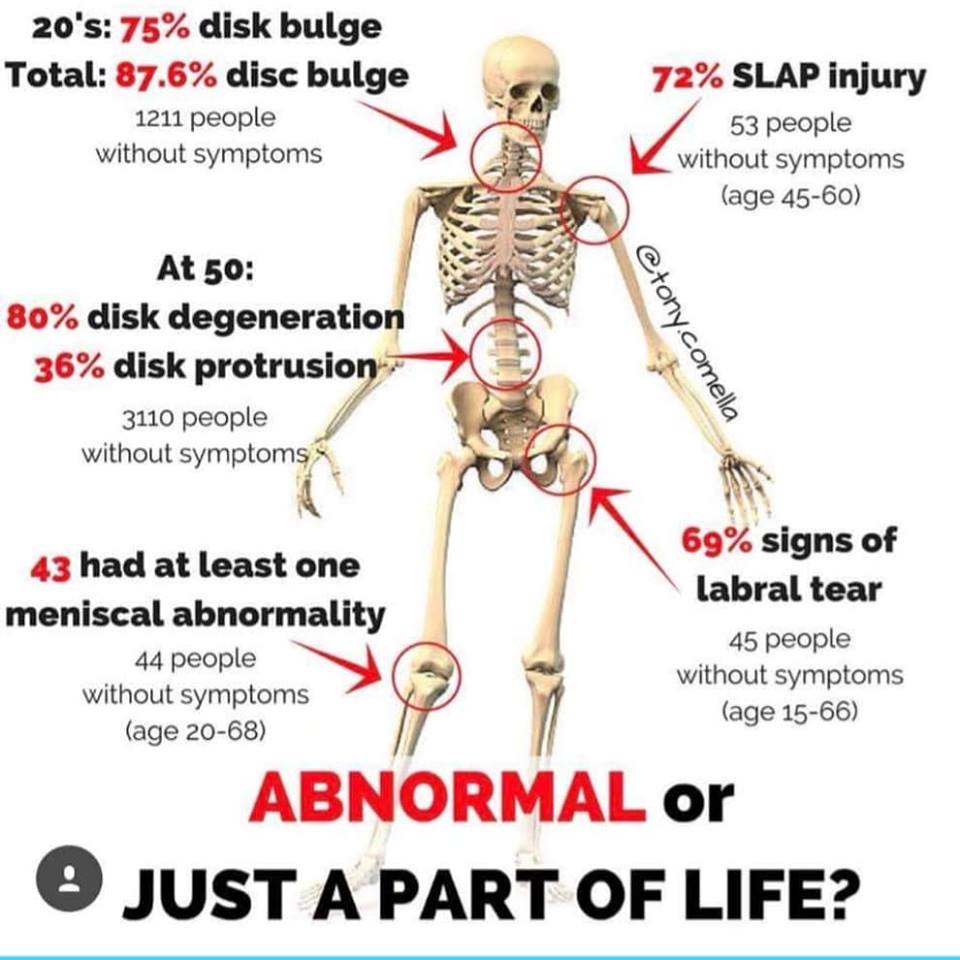
In fact, the latest MRI studies on people without back pain show that at age 30, you have a 52% chance of having disc degeneration. By age 40, you have a 50% chance of having a bulging disc (Brinjijki ET 2014, American Journal of Neuroradiology). Yet, these people do not suffer from pain. How can this be? Because, as Professor Lorimer Mosley states, “pain does not reflect tissue health.” Disc degeneration and bulging discs are part of the aging process. The fact that Doris had back pain and a bulging disc was just a mere, albeit common, coincidence.
It’s not just health professionals who need to watch their words. How many times has a nosy neighbor diagnosed your knee pain as tendinitis or your hip pain as arthritis without any evidence or qualification? While they continue with their day, you carry that misinformation. These comments affect the psychological aspect of pain. So, before giving someone “advice” without knowing the facts, think about the lasting effects your words can have.
Conclusion
If you’re experiencing pain or injury problems, whether in your back or elsewhere, we’re here to help at our physio clinic in Athlone. For more information and to read other reports I’ve written, click the links below.
For personalized advice and treatment, please don’t hesitate to reach out. You can call our physio clinic in Athlone or have a look to see what availability we have on our calendar by CLICKING HERE.
Remember we offer a free 20-minute consultation for those who want to see if we can help them.